
city
👋 Hello! It looks like you're visiting from the US. Do you want to visit our American site?
👋 Hello! It looks like you're visiting from the UK. Do you want to visit our UK site?
👋 Hello! It looks like you're visiting from Australia. Do you want to visit our Australian site?
×

Why Law Firms Must Prioritize Collaboration with Firm Growth

As law firms grow, collaboration often breaks down. Learn how smarter systems, AI, training, and visibility help teams stay aligned and succeed in the long term.

Smokeball Logo
Written by Smokeball
March 30, 2026
3 min read
Smokeball Logo
Written by
March 30, 2026
3 min read
Smokeball Logo
Written by Jordan Turk
March 30, 2026
3 min read
Why Law Firms Must Prioritize Collaboration with Firm Growth
Explore Smokeball
Get Pricing
Explore Smokeball
  • Bill accurately with AutoTime
  • Integrate with Word & Outlook
  • Access 20,000 - prebuilt legal forms
  • Grow with smart reports & insights
Get Pricing

Growth Is a Great Problem…Until Your Firm Stops Working Like a Team

Growth is a great problem to have. Most firms work hard to reach it.

But there’s a stage in a firm’s growth where something subtle (and potentially dangerous) starts to happen. The habits that worked when the team was smaller begin to break down.

Questions that used to get answered instantly now sit in someone’s inbox. Attorneys discover matter updates later than they should. Workloads become uneven. And partners wonder why the firm suddenly feels less connected and coordinated than it did a year ago.

This isn’t unusual. In fact, it’s one of the most common growing pains in the legal industry.

Research has found that employees spend nearly 20% of their workweek searching for information or tracking down colleagues for answers. In law firms, where matters depend on timely information and coordination, that time is crucial.

None of this happens because people stop caring, but because growth introduces complexity. At some point, collaboration can’t rely on proximity or quick conversations down the hall. It must be more intentional.

The firms that scale sustainably stop relying on informal habits and start building structures that make it easier for the entire team to stay aligned, support one another, and keep work moving efficiently.

The shift doesn’t require reinventing how your firm practices law, but it does require rethinking how information, work, and responsibility move across the team.

The most successful firms build collaboration into the infrastructure of the practice.

Stop Letting Client Communication Live in One Person’s Inbox

In many firms, client communication naturally centers around one person—usually the attorney handling the matter or the assistant supporting them. That makes sense on paper, but unintentionally creates potential for single points of failure.

When questions, documents, and updates are buried in individual email threads, the rest of the team doesn’t have visibility. And if that one person is tied up in court or out of the office, clients are left waiting.

Firms are solving this by moving client communication into secure, shared client portals.

Instead of comms and information living in one person’s inbox, client communications live in one centralized place all staff can access. This allows full internal transparency, better support, and happier clients. Additionally, client can upload documents, check on matter status, and have one streamlined place to interact with your firm.

The result is simple but powerful:
Anyone on the team  can step in and help.

That doesn’t just improve responsiveness, it spreads knowledge across the firm and prevents matters from depending on a single person, giving the team more opportunities to support one another and keep work moving.

Visualize What’s Actually Happening in the Firm

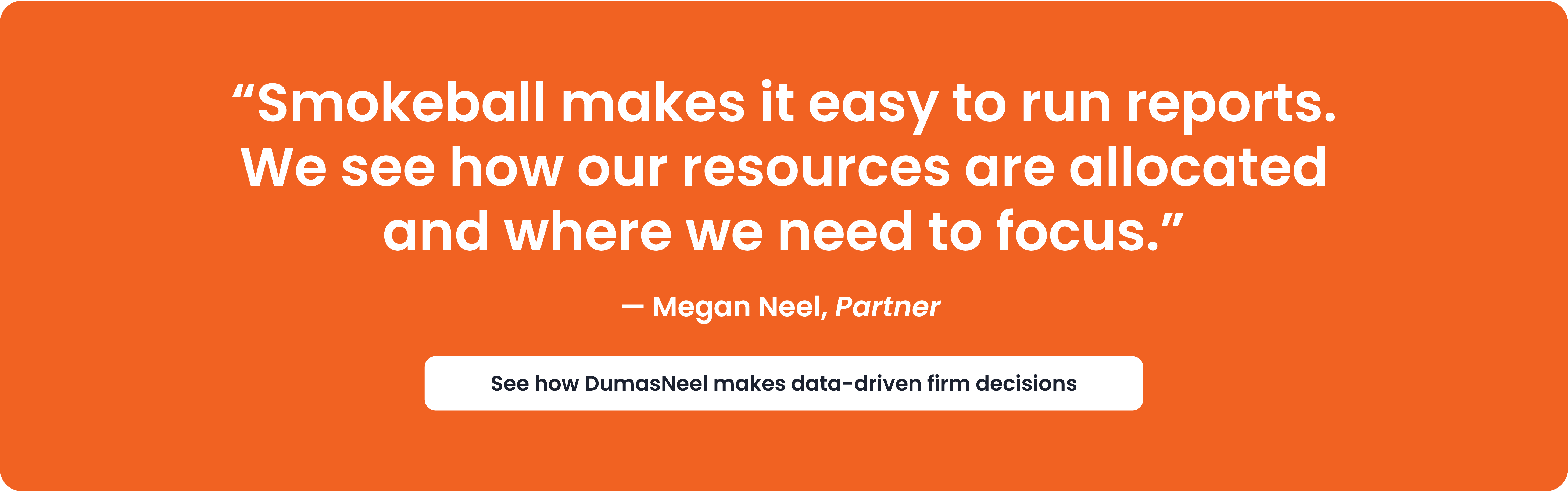
One of the hardest parts of managing a growing firm is understanding where the pressure points really are. Many firms assume they know where work is happening simply because they’re involved in the matters. But once a firm reaches a certain level of complexity, that intuition becomes less reliable.

From the outside, everything may look fine. But internally, certain team members may be overloaded while others have room to take on more work. Matters may be slowing down in ways that aren’t immediately visible.

This is where firm-wide reporting and operational insights start to matter.

When leadership can see how work is distributed across the firm, it becomes much easier to answer questions like:

  • Where are we hitting bottlenecks?
  • Who has capacity to help with new matters?
  • Which types of work are consuming the most time?
  • Are deadlines stacking up in ways that could create stress on the team?

Instead of relying purely on instinct or what you think the workload is, firms can start making decisions with real visibility into how work is moving through the practice.

And when that visibility exists, collaboration tends to improve naturally. People can step in to help before problems escalate.
Treat Calendaring as an Operational Tool, Not Just a Reminder System

Every law firm understands the importance of calendaring deadlines and court dates. But in growing firms, calendaring stops being just a compliance safeguard. It becomes an operational coordination system. Calendaring needs to do more than just keep individuals organized.

It needs to help the entire firm coordinate its work.

When calendars live in isolated systems, it becomes difficult to see how schedules overlap. Attorneys may unknowingly double-book time, staff may struggle to plan ahead, and the firm loses an opportunity to anticipate busy periods.

A centralized calendaring system changes that dynamic.

When everyone has visibility into deadlines, hearings, and upcoming events, it becomes easier to coordinate coverage, plan workloads, and avoid surprises.

Calendaring stops being a personal task-management tool and becomes part of how the firm operates day to day.

Make Training and Onboarding Part of Your Firm’s Infrastructure

When teams are smaller, training tends to happen naturally. New hires sit next to experienced team members, ask questions throughout the day, and gradually pick up how things work just by being around the practice.

But as a firm grows, that kind of informal learning becomes harder to sustain.

Too often, onboarding turns into a quick orientation (a packet of materials, a few recorded trainings, maybe a walkthrough of the firm’s systems) and then the expectation that new hires will figure the rest out along the way. This is one of the most common mistakes growing firms make. They invest heavily in hiring talent, but underestimate how much structure it takes to help that talent integrate into the firm’s workflows.

Take a different approach. Treat training and onboarding as ongoing parts of how the firm operates, not a one-time event during someone’s first week.  

That means creating clear processes for how new team members learn the firm’s workflows, ensuring everyone is comfortable with the tools the firm relies on, and making sure support is always available when questions inevitably come up.

Just as importantly, it means continuing to invest in training long after onboarding is complete—whether that’s helping staff refine workflows, learn new capabilities in the firm’s software, or adopt new technologies that improve how the team works together.

When firms make training part of their operational foundation rather than a checkbox during hiring, the payoff is significant. New hires ramp up faster, teams operate more consistently, and everyone has the confidence to collaborate effectively. That shared understanding becomes one of the biggest factors in keeping the entire practice running smoothly.

Start Thinking About AI as a Team Productivity Tool

AI is often introduced as a time-saving technology for law firms (and it absolutely delivers on that promise). But it’s just as powerful in distributing knowledge across the team.

When implemented thoughtfully, legal-specific AI helps teams work together more efficiently in several practical ways:

Helping team members quickly understand a matter’s history

AI tools for lawyers can summarize case files, documents, and communications so anyone stepping in can quickly grasp what’s happened, what’s outstanding, and what needs attention next. Instead of relying on a colleague to walk them through every detail of a case, newer attorneys or staff can review AI-generated summaries to build context on their own.

Answering internal questions without interrupting colleagues

Instead of asking a teammate to dig through files or emails for a specific detail, an AI matter assistant can surface information from the matter itself, allowing team members to find what they need without slowing someone else down.

Turning complex documents into clear insights for the team
Legal AI tools and integrations can analyze long or technical documents, producing concise summaries while also identifying key patterns, risks, or arguments across case materials. This helps the team understand important details faster and collaborate more effectively—without everyone needing to review every page before contributing.

Making it easier to draft and refine communications

Whether preparing internal updates, drafting emails to clients, or outlining next steps on a matter, legal AI tools help team members generate first drafts quickly, allowing colleagues to collaborate and refine the work rather than starting from scratch.

Reducing administrative friction around financial and operational tasks

AI-powered integrations can also help automate certain operational processes, such as tracking financial activity or managing billing-related workflows, so teams spend less time coordinating administrative work and more time focusing on client matters.

When used this way, the result is a firm where information is easier to access, team members can contribute more quickly, and matters keep moving—even when the people working on them change.

Building Systems That Support Your People

Every growing firm  eventually discovers the same thing: the informal systems that worked early on don’t scale. And the practice has reached a stage where collaboration needs stronger infrastructure. Left unchecked, those gaps create friction like missed information, uneven workloads, and a culture gap as the firm grows.

Law firms that address collaboration intentionally see the opposite effect.  

Work moves faster, knowledge spreads easily, teams step in for one another without disruption, and clients experience a practice that feels coordinated rather than fragmented. The firm begins to function less like a collection of individuals and more like a well-run business.

Because at a certain point, scaling a law firm isn’t just about bringing in more clients, it’s about building a firm where the entire team can move together.


👋 Hello! It looks like you're visiting from the US. Do you want to visit our American site?
👋 Hello! It looks like you're visiting from the UK. Do you want to visit our UK site?
👋 Hello! It looks like you're visiting from Australia. Do you want to visit our Australian site?
×

Why Law Firms Must Prioritize Collaboration with Firm Growth

Written by

|

March 30, 2026

Smokeball Logo

Written by Smokeball

|

March 30, 2026

Jordan Turk

Written by Jordan Turk

|

March 30, 2026

Why Law Firms Must Prioritize Collaboration with Firm Growth

Growth Is a Great Problem…Until Your Firm Stops Working Like a Team

Growth is a great problem to have. Most firms work hard to reach it.

But there’s a stage in a firm’s growth where something subtle (and potentially dangerous) starts to happen. The habits that worked when the team was smaller begin to break down.

Questions that used to get answered instantly now sit in someone’s inbox. Attorneys discover matter updates later than they should. Workloads become uneven. And partners wonder why the firm suddenly feels less connected and coordinated than it did a year ago.

This isn’t unusual. In fact, it’s one of the most common growing pains in the legal industry.

Research has found that employees spend nearly 20% of their workweek searching for information or tracking down colleagues for answers. In law firms, where matters depend on timely information and coordination, that time is crucial.

None of this happens because people stop caring, but because growth introduces complexity. At some point, collaboration can’t rely on proximity or quick conversations down the hall. It must be more intentional.

The firms that scale sustainably stop relying on informal habits and start building structures that make it easier for the entire team to stay aligned, support one another, and keep work moving efficiently.

The shift doesn’t require reinventing how your firm practices law, but it does require rethinking how information, work, and responsibility move across the team.

The most successful firms build collaboration into the infrastructure of the practice.

Stop Letting Client Communication Live in One Person’s Inbox

In many firms, client communication naturally centers around one person—usually the attorney handling the matter or the assistant supporting them. That makes sense on paper, but unintentionally creates potential for single points of failure.

When questions, documents, and updates are buried in individual email threads, the rest of the team doesn’t have visibility. And if that one person is tied up in court or out of the office, clients are left waiting.

Firms are solving this by moving client communication into secure, shared client portals.

Instead of comms and information living in one person’s inbox, client communications live in one centralized place all staff can access. This allows full internal transparency, better support, and happier clients. Additionally, client can upload documents, check on matter status, and have one streamlined place to interact with your firm.

The result is simple but powerful:
Anyone on the team  can step in and help.

That doesn’t just improve responsiveness, it spreads knowledge across the firm and prevents matters from depending on a single person, giving the team more opportunities to support one another and keep work moving.

Visualize What’s Actually Happening in the Firm

One of the hardest parts of managing a growing firm is understanding where the pressure points really are. Many firms assume they know where work is happening simply because they’re involved in the matters. But once a firm reaches a certain level of complexity, that intuition becomes less reliable.

From the outside, everything may look fine. But internally, certain team members may be overloaded while others have room to take on more work. Matters may be slowing down in ways that aren’t immediately visible.

This is where firm-wide reporting and operational insights start to matter.

When leadership can see how work is distributed across the firm, it becomes much easier to answer questions like:

  • Where are we hitting bottlenecks?
  • Who has capacity to help with new matters?
  • Which types of work are consuming the most time?
  • Are deadlines stacking up in ways that could create stress on the team?

Instead of relying purely on instinct or what you think the workload is, firms can start making decisions with real visibility into how work is moving through the practice.

And when that visibility exists, collaboration tends to improve naturally. People can step in to help before problems escalate.

Treat Calendaring as an Operational Tool, Not Just a Reminder System

Every law firm understands the importance of calendaring deadlines and court dates. But in growing firms, calendaring stops being just a compliance safeguard. It becomes an operational coordination system. Calendaring needs to do more than just keep individuals organized.

It needs to help the entire firm coordinate its work.

When calendars live in isolated systems, it becomes difficult to see how schedules overlap. Attorneys may unknowingly double-book time, staff may struggle to plan ahead, and the firm loses an opportunity to anticipate busy periods.

A centralized calendaring system changes that dynamic.

When everyone has visibility into deadlines, hearings, and upcoming events, it becomes easier to coordinate coverage, plan workloads, and avoid surprises.

Calendaring stops being a personal task-management tool and becomes part of how the firm operates day to day.

Make Training and Onboarding Part of Your Firm’s Infrastructure

When teams are smaller, training tends to happen naturally. New hires sit next to experienced team members, ask questions throughout the day, and gradually pick up how things work just by being around the practice.

But as a firm grows, that kind of informal learning becomes harder to sustain.

Too often, onboarding turns into a quick orientation (a packet of materials, a few recorded trainings, maybe a walkthrough of the firm’s systems) and then the expectation that new hires will figure the rest out along the way. This is one of the most common mistakes growing firms make. They invest heavily in hiring talent, but underestimate how much structure it takes to help that talent integrate into the firm’s workflows.

Take a different approach. Treat training and onboarding as ongoing parts of how the firm operates, not a one-time event during someone’s first week.  

That means creating clear processes for how new team members learn the firm’s workflows, ensuring everyone is comfortable with the tools the firm relies on, and making sure support is always available when questions inevitably come up.

Just as importantly, it means continuing to invest in training long after onboarding is complete—whether that’s helping staff refine workflows, learn new capabilities in the firm’s software, or adopt new technologies that improve how the team works together.

When firms make training part of their operational foundation rather than a checkbox during hiring, the payoff is significant. New hires ramp up faster, teams operate more consistently, and everyone has the confidence to collaborate effectively. That shared understanding becomes one of the biggest factors in keeping the entire practice running smoothly.

Start Thinking About AI as a Team Productivity Tool

AI is often introduced as a time-saving technology for law firms (and it absolutely delivers on that promise). But it’s just as powerful in distributing knowledge across the team.

When implemented thoughtfully, legal-specific AI helps teams work together more efficiently in several practical ways:

Helping team members quickly understand a matter’s history

AI tools for lawyers can summarize case files, documents, and communications so anyone stepping in can quickly grasp what’s happened, what’s outstanding, and what needs attention next. Instead of relying on a colleague to walk them through every detail of a case, newer attorneys or staff can review AI-generated summaries to build context on their own.

Answering internal questions without interrupting colleagues

Instead of asking a teammate to dig through files or emails for a specific detail, an AI matter assistant can surface information from the matter itself, allowing team members to find what they need without slowing someone else down.

Turning complex documents into clear insights for the team
Legal AI tools and integrations can analyze long or technical documents, producing concise summaries while also identifying key patterns, risks, or arguments across case materials. This helps the team understand important details faster and collaborate more effectively—without everyone needing to review every page before contributing.

Making it easier to draft and refine communications

Whether preparing internal updates, drafting emails to clients, or outlining next steps on a matter, legal AI tools help team members generate first drafts quickly, allowing colleagues to collaborate and refine the work rather than starting from scratch.

Reducing administrative friction around financial and operational tasks

AI-powered integrations can also help automate certain operational processes, such as tracking financial activity or managing billing-related workflows, so teams spend less time coordinating administrative work and more time focusing on client matters.

When used this way, the result is a firm where information is easier to access, team members can contribute more quickly, and matters keep moving—even when the people working on them change.

Building Systems That Support Your People

Every growing firm  eventually discovers the same thing: the informal systems that worked early on don’t scale. And the practice has reached a stage where collaboration needs stronger infrastructure. Left unchecked, those gaps create friction like missed information, uneven workloads, and a culture gap as the firm grows.

Law firms that address collaboration intentionally see the opposite effect.  

Work moves faster, knowledge spreads easily, teams step in for one another without disruption, and clients experience a practice that feels coordinated rather than fragmented. The firm begins to function less like a collection of individuals and more like a well-run business.

Because at a certain point, scaling a law firm isn’t just about bringing in more clients, it’s about building a firm where the entire team can move together.

Related Product Content

A smiling person wearing a collared shirt, tie, and glasses, works on a laptop at a coffee shop.

9 Legal AI Tools US Law Firms Are Using in 2026

No items found.
Download Smokeball's "The Lawyer's Guide to Disaster Planning" eBook

The Lawyer's Guide to Disaster Planning

Book Your Free Demo

Ready to see how Smokeball client intake software helps you Run Your Best Firm? Schedule your free demo!

This field is required.

This field is required.

This field is required.

This field is required.

This field is required.

Your personal data will be kept confidential. By sharing your phone number, you agree to receive promotional messages and/or phone calls from Smokeball. Consent is not a condition of purchase. View our Privacy Policy and Terms of Service for more information.

Thank you! Your submission has been received!
Oops! Something went wrong while submitting the form.

More from the Smokeball blog