
city
👋 Hello! It looks like you're visiting from the US. Do you want to visit our American site?
👋 Hello! It looks like you're visiting from the UK. Do you want to visit our UK site?
👋 Hello! It looks like you're visiting from Australia. Do you want to visit our Australian site?
×

Inclusion as Strength: Lessons for the Next Generation of Law Firms

A San Antonio law school proves representation strengthens law firms. Here’s what mid-size firms can learn about diversity, pipelines, and client trust.

Smokeball Logo
Written by Smokeball
October 3, 2025
3 min read
Smokeball Logo
Written by
October 3, 2025
3 min read
Smokeball Logo
Written by Jordan Turk
October 3, 2025
3 min read
Inclusion as Strength: Lessons for the Next Generation of Law Firms
Explore Smokeball
Get Pricing
Explore Smokeball
  • Bill accurately with AutoTime
  • Integrate with Word & Outlook
  • Access 20,000 - prebuilt legal forms
  • Grow with smart reports & insights
Get Pricing

The legal profession is one of the most respected fields, yet it’s no secret that it carries a reputation problem. For too long, courtrooms and firms have felt more like exclusive clubs than welcoming institutions. But here’s the good news: communities are changing, and the legal profession has an opportunity to evolve with them.

One law school in San Antonio — St. Mary’s University School of Law — is proving what’s possible when institutions actually walk the walk on representation.

This isn’t just about optics. It’s about trust, advocacy, and a generation of lawyers who reflect the communities they serve. If you’re running a mid-size firm there’s a business case  you can’t afford to ignore.

First, a Reality Check

According to the ABA’s Profile of the Legal Profession 2024, nearly 8 in 10 lawyers are white. Meanwhile, Hispanic attorneys make up just 5% of the profession, even though Hispanic people account for about 20% of the U.S. population. That gap isn’t just a statistic; it’s a credibility issue. A lack of representation can undermine trust, weaken advocacy, and make law firms look out of touch with the very people they’re passionate about representing.  

The numbers speak for themselves — and they spell opportunity for firms willing to lead.
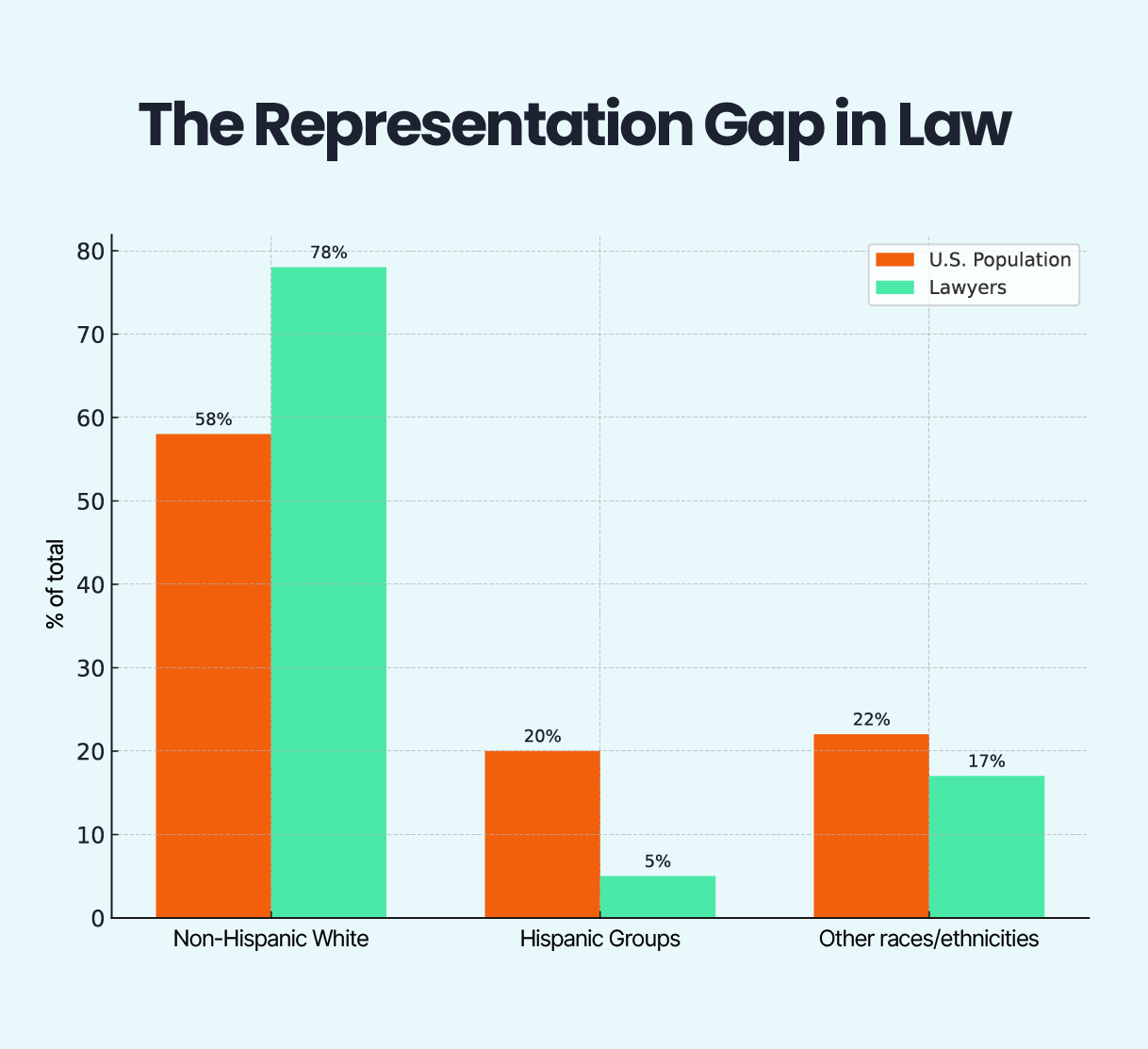
Source: American Bar Association

The bright side is that law school enrollment is diversifying. Just last year, more than 40% of incoming students identified as people of color. But as the UC Davis faculty blog bluntly puts it: the real goal isn’t diverse campuses, it’s a diverse profession. Which brings us back to St. Mary’s.

A Pipeline with Purpose

At St. Mary’s Law, nearly half of J.D. students identify as Hispanic, and around 55% identify as minorities overall. Those numbers aren’t accidental. They’re the product of intentional recruitment, scholarships, and support systems designed to make sure students don’t just enroll — they graduate and thrive. Think of St. Mary’s as a case study in how diversity scales.  

St. Mary’s is more than a school; it’s a model for how diversity can fuel continuous growth in law firms:

  • Mentorship that multiplies → By connecting first-gen students with alumni and faculty mentors, new lawyers gain confidence and find a sense of belonging.  
  • Recruitment with intention → Scholarships and outreach programs help more students of color enter and finish law school, strengthening the pool of future hires.
  • Cultural fluency in training → Working alongside classmates from different backgrounds prepares graduates to serve a wide range of clients with empathy and insight, sharpening their advocacy skills.
  • Pipeline planning → A broad mix of students today leads to a more representative bar and bench tomorrow, demonstrating what long-term succession planning can look like in practice.  

Their efforts display how law firms can realistically put diversity and representation to practice in the profession.  

How Mid-Size Law Firms Can Build a More Inclusive Team

For mid-size firms, the beauty of this approach is speed and agility. You don’t need committees, endless reports, or Big Law budgets to move the needle.

A few moves that matter:

  • Recruit where the talent is. Schools like St. Mary’s are producing bilingual, community-connected grads. Show up at their events. Sponsor scholarships. Hire consistently — not just when you need to tick a box.
  • Double down on mentorship. Pair new associates with both a practice mentor and a “culture” mentor. Attrition rates drop, pipelines stay healthy, and you get a stronger team.
  • Measure what matters. Diversity efforts without metrics are just press releases. Track candidate slates, retention, and promotion rates the same way you’d track revenue or client intake.
  • Meet clients where they are. In San Antonio, bilingual intake isn’t a perk, it’s table stakes. Investing in culturally fluent teams isn’t charity, it’s client service 101.
  • Leverage technology smartly. The right tools won’t replace great lawyers, but they can automate routine tasks and free up time for what really drives impact: mentorship, relationship-building, and strengthening client trust.

And yes, this has a bottom-line impact. As the Pennsylvania Bar Institute points out: "Diverse legal teams reflect client diversity, build confidence, and drive firm growth."

The Impact of Inclusion

Diversity isn’t a checkbox. When given the proper focus, it becomes a multiplier for every part of your firm.

  • Market insight built in. Diverse teams don’t just reflect communities—they understand them. Negotiation, mediation, client relations: all improved when context and nuance are already in your toolkit.
  • Innovation through perspective. Different backgrounds and problem-solving styles lead to creative strategies and new opportunities. For mid-size firms competing with Big Law, this is a differentiator.
  • Talent magnetism. Top candidates want growth, mentorship, and inclusion. Structured diversity programs attract ambitious lawyers who perform better and stay longer.
  • Client confidence = firm growth. Representation builds trust, and trust drives business. Referrals and loyalty increasingly go to firms that mirror the communities they serve.
  • Succession planning as strategy. Early investment in mentorship and leadership pipelines ensures your firm evolves organically, avoiding disruption when senior partners retire.

Diversity, done right, is a lever that grows talent, client trust, and your bottom line.

Technology as a Quiet Ally

Software won’t replace great representation. But the right tools can smooth out some of the hurdles that often hit first-gen lawyers and associates of color the hardest.

Think:

  • Automated workflows that take the guesswork out of “unspoken” processes
  • Centralized communication logs that track conversations in English, Spanish, and more
  • Document templates that give every new hire the same roadmap to succeed.

Legal software platforms aren’t a silver bullet, but they can free up time for the human stuff that actually moves the needle: mentorship, relationship-building, and client trust.

RELATED: How Law Firms Make or Break Client Trust

Beyond The Conversation

The stats are sobering: 78% of attorneys are still white, women are under 40% of the bar, Hispanic attorneys remain drastically underrepresented. But law schools like St. Mary’s show how we can meaningfully reshape the profession so lawyers reflect the communities and people they represent.

And for mid-size firms, the message is clear: this isn’t a side project. It’s a defining strategy. Recruit intentionally. Mentor relentlessly. Measure consistently. Use tech smartly. Do this, and your mid-size firm won’t just keep pace with the profession’s future — you’ll help define it.


👋 Hello! It looks like you're visiting from the US. Do you want to visit our American site?
👋 Hello! It looks like you're visiting from the UK. Do you want to visit our UK site?
👋 Hello! It looks like you're visiting from Australia. Do you want to visit our Australian site?
×

Inclusion as Strength: Lessons for the Next Generation of Law Firms

Written by

|

September 17, 2025

Smokeball Logo

Written by Smokeball

|

September 17, 2025

Jordan Turk

Written by Jordan Turk

|

September 17, 2025

Inclusion as Strength: Lessons for the Next Generation of Law Firms

The legal profession is one of the most respected fields, yet it’s no secret that it carries a reputation problem. For too long, courtrooms and firms have felt more like exclusive clubs than welcoming institutions. But here’s the good news: communities are changing, and the legal profession has an opportunity to evolve with them.

One law school in San Antonio — St. Mary’s University School of Law — is proving what’s possible when institutions actually walk the walk on representation.

This isn’t just about optics. It’s about trust, advocacy, and a generation of lawyers who reflect the communities they serve. If you’re running a mid-size firm there’s a business case  you can’t afford to ignore.

First, a Reality Check

According to the ABA’s Profile of the Legal Profession 2024, nearly 8 in 10 lawyers are white. Meanwhile, Hispanic attorneys make up just 5% of the profession, even though Hispanic people account for about 20% of the U.S. population. That gap isn’t just a statistic; it’s a credibility issue. A lack of representation can undermine trust, weaken advocacy, and make law firms look out of touch with the very people they’re passionate about representing.  

The numbers speak for themselves — and they spell opportunity for firms willing to lead.

Source: American Bar Association

The bright side is that law school enrollment is diversifying. Just last year, more than 40% of incoming students identified as people of color. But as the UC Davis faculty blog bluntly puts it: the real goal isn’t diverse campuses, it’s a diverse profession. Which brings us back to St. Mary’s.

A Pipeline with Purpose

At St. Mary’s Law, nearly half of J.D. students identify as Hispanic, and around 55% identify as minorities overall. Those numbers aren’t accidental. They’re the product of intentional recruitment, scholarships, and support systems designed to make sure students don’t just enroll — they graduate and thrive. Think of St. Mary’s as a case study in how diversity scales.  

St. Mary’s is more than a school; it’s a model for how diversity can fuel continuous growth in law firms:

  • Mentorship that multiplies → By connecting first-gen students with alumni and faculty mentors, new lawyers gain confidence and find a sense of belonging.  
  • Recruitment with intention → Scholarships and outreach programs help more students of color enter and finish law school, strengthening the pool of future hires.
  • Cultural fluency in training → Working alongside classmates from different backgrounds prepares graduates to serve a wide range of clients with empathy and insight, sharpening their advocacy skills.
  • Pipeline planning → A broad mix of students today leads to a more representative bar and bench tomorrow, demonstrating what long-term succession planning can look like in practice.  

Their efforts display how law firms can realistically put diversity and representation to practice in the profession.  

How Mid-Size Law Firms Can Build a More Inclusive Team

For mid-size firms, the beauty of this approach is speed and agility. You don’t need committees, endless reports, or Big Law budgets to move the needle.

A few moves that matter:

  • Recruit where the talent is. Schools like St. Mary’s are producing bilingual, community-connected grads. Show up at their events. Sponsor scholarships. Hire consistently — not just when you need to tick a box.
  • Double down on mentorship. Pair new associates with both a practice mentor and a “culture” mentor. Attrition rates drop, pipelines stay healthy, and you get a stronger team.
  • Measure what matters. Diversity efforts without metrics are just press releases. Track candidate slates, retention, and promotion rates the same way you’d track revenue or client intake.
  • Meet clients where they are. In San Antonio, bilingual intake isn’t a perk, it’s table stakes. Investing in culturally fluent teams isn’t charity, it’s client service 101.
  • Leverage technology smartly. The right tools won’t replace great lawyers, but they can automate routine tasks and free up time for what really drives impact: mentorship, relationship-building, and strengthening client trust.

And yes, this has a bottom-line impact. As the Pennsylvania Bar Institute points out: "Diverse legal teams reflect client diversity, build confidence, and drive firm growth."

The Impact of Inclusion

Diversity isn’t a checkbox. When given the proper focus, it becomes a multiplier for every part of your firm.

  • Market insight built in. Diverse teams don’t just reflect communities—they understand them. Negotiation, mediation, client relations: all improved when context and nuance are already in your toolkit.
  • Innovation through perspective. Different backgrounds and problem-solving styles lead to creative strategies and new opportunities. For mid-size firms competing with Big Law, this is a differentiator.
  • Talent magnetism. Top candidates want growth, mentorship, and inclusion. Structured diversity programs attract ambitious lawyers who perform better and stay longer.
  • Client confidence = firm growth. Representation builds trust, and trust drives business. Referrals and loyalty increasingly go to firms that mirror the communities they serve.
  • Succession planning as strategy. Early investment in mentorship and leadership pipelines ensures your firm evolves organically, avoiding disruption when senior partners retire.

Diversity, done right, is a lever that grows talent, client trust, and your bottom line.

Technology as a Quiet Ally

Software won’t replace great representation. But the right tools can smooth out some of the hurdles that often hit first-gen lawyers and associates of color the hardest.

Think:

  • Automated workflows that take the guesswork out of “unspoken” processes
  • Centralized communication logs that track conversations in English, Spanish, and more
  • Document templates that give every new hire the same roadmap to succeed.

Legal software platforms aren’t a silver bullet, but they can free up time for the human stuff that actually moves the needle: mentorship, relationship-building, and client trust.

RELATED: How Law Firms Make or Break Client Trust

Beyond The Conversation

The stats are sobering: 78% of attorneys are still white, women are under 40% of the bar, Hispanic attorneys remain drastically underrepresented. But law schools like St. Mary’s show how we can meaningfully reshape the profession so lawyers reflect the communities and people they represent.

And for mid-size firms, the message is clear: this isn’t a side project. It’s a defining strategy. Recruit intentionally. Mentor relentlessly. Measure consistently. Use tech smartly. Do this, and your mid-size firm won’t just keep pace with the profession’s future — you’ll help define it.

Related Product Content

Behind the Firm: How One Family Law Firm Mastered Mentorship

Behind the Firm: How One Family Law Firm Mastered Mentorship

No items found.
Smokeball's 2025 State of Law Report

2025 State of Law: Adapting for Resilience and Growth in a Tech-Driven Age

Book Your Free Demo

Ready to see how Smokeball client intake software helps you Run Your Best Firm? Schedule your free demo!

This field is required.

This field is required.

This field is required.

This field is required.

This field is required.

Your personal data will be kept confidential. By sharing your phone number, you agree to receive promotional messages and/or phone calls from Smokeball. Consent is not a condition of purchase. View our Privacy Policy and Terms of Service for more information.

Thank you! Your submission has been received!
Oops! Something went wrong while submitting the form.

More from the Smokeball blog